
FIRST PRINCIPLE
Signals are evidence. They are not understanding.
Logs, metrics, traces, tickets, policies, documents, code, and configuration all describe pieces of reality.
But evidence is not the same as comprehension.
The old stack was built to collect, alert, monitor, ticket, and report. Each system became useful inside its own domain. None of them was designed to create shared understanding across the whole enterprise.
That is the first architectural break Eccis makes.
Eccis is not designed around collecting more signals. It is designed around turning the right signals into context that can be reasoned over.
The Input Model
Eccis is built around the classes of signal that define enterprise reality.
Systems and state
Infrastructure state, cloud configuration, orchestration environments, application context, and data systems.
Security and identity
Security posture, identity and access, permissions, exposure, and audit trails. For every change: who made it and when, read from the systems' own change records. Not inferred. Read.
Governance and knowledge
Compliance policies, controls, runbooks, documentation, tickets, decisions, and operating history.
Change and activity
Code, dependency changes, developer activity, configuration changes, deployments, incidents, and operational memory.
The input model is not a connector list. It is the architecture's view of what must be understood before enterprise AI can act safely.
Agents inside your clusters ride the cluster's own watch machinery, streaming running state as it changes: workloads, services, configuration, secrets metadata, access rules, network policy, scheduled jobs. Where an agent cannot be installed, an agentless connection reads the same state. Declared intent comes from your repositories and infrastructure-as-code. Eccis holds both: what is running, where it runs, and how it connects.
Everything stays where it runs.
FIRST PRINCIPLE
Infrastructure is state, and state changes continuously.
An enterprise technology environment is not a static diagram.
It is the current state of code, configuration, infrastructure, cloud resources, identities, permissions, policies, dependencies, data movement, risk, and operating history.
Every deployment changes state. Every permission changes state. Every dependency changes state. Every policy exception changes state. Every incident changes what the system knows.
The management problem is not visibility alone. It is state comprehension.
The Shared Understanding Layer
Eccis continuously models what exists, what changed, what it depends on, why it matters, and what should happen next.
The result is a living semantic model of the enterprise technology surface: state, intent, dependencies, risk, compliance, security context, and operational memory understood together.
This model is built for people and machines at the same time. An engineer can understand what changed. A security leader can understand what is exposed. A compliance team can understand what is affected. An AI agent can reason from the same model instead of guessing from fragmented context.
Live semantic model
The enterprise represented as changing state, not a stale snapshot.
Dependency awareness
What connects to what, and what each change touches.
Risk and policy context
Security, compliance, and governance carried alongside the technical model.
Operational memory
A durable record of what happened, what changed, and what worked.
Human-readable and machine-readable
One model that serves engineers, leaders, systems, and AI.
State, intent, and drift
State and intent sit side by side, and the distance between them is measured. That distance is drift: what was declared against what is running, compared semantically, noise ignored, every difference scored by severity. A changed image is critical. A label is low. The score is held live, so the model always knows how far reality has moved from the plan.
And the model is not frozen. Eccis proposes revisions to its own ontology, attacks each proposal adversarially, and commits only what survives. The model of your enterprise argues with itself before it believes anything.
The same truth, for everyone.
FIRST PRINCIPLE
Retrieval is not reasoning.
Finding similar text is not the same as knowing what matters.
A retrieval system can surface related documents. A graph can store relationships. A rules engine can encode known conditions. A workflow tool can run a fixed script.
None of those, by itself, answers the question enterprise AI actually faces: what changed, what does it affect, why does it matter, and what should happen next?
The ECCS Reasoning Core
At the center of Eccis is the ECCS reasoning core.
ECCS is the reasoning layer that evaluates change against context, dependencies, risk, security, compliance, and governance requirements before recommending action.
How reasoning flows
An event or change arrives.
Eccis finds the relevant verified context.
ECCS reasons across dependencies and impact.
Risk, security, and compliance context are evaluated together.
A recommended action is produced.
Approval, policy, and auditability govern what happens next.
Reasoning fires when reality changes, not on a schedule.
The self-check
The signature move: before ECCS asserts anything, it checks itself. The engine extracts the claims inside its own analysis, verifies each one against the live system graph, computes the blast radius of everything verified, then re-reasons with the facts attached. When ECCS says a change matters, it has already proven why, and it already knows what breaks.
Reasoning that checks its own work.
Reasoning forward
The engine reasons forward too. It measures how fast an environment is drifting and whether the drift is accelerating, correlates that with resource metrics and historical patterns, and returns a probability, a time window, the contributing factors, and the prevention actions. Every prediction is scored against what actually happened. The engine tunes itself to each environment.
The point is not to retrieve more context. The point is to know which context changes the decision.
MAXIMUS BLACKBOURNE, CTO
FIRST PRINCIPLE
Enterprise AI needs warranted reasoning.
Enterprise AI cannot act safely from a flat prompt, a pile of logs, or a similarity search.
The reasoning layer has to know what it believes, why it believes it, what evidence matters, and what must be true before an action is safe.
That is why Eccis is built around warranted reasoning. A recommendation does not float beside the system as a suggestion. It carries the context that produced it, the dependencies it affects, the risks it introduces, the policies it touches, and the approval path required to act.
Reasoning Principles
Belief-state reasoning
Eccis reasons from a maintained understanding of the enterprise, not a single prompt window.
Cause and effect
Understanding is organized around what drives what, not only what appears similar.
Measurement before action
When state is uncertain, the system seeks the check that resolves the uncertainty, then acts.
Decision sufficiency
The engine stops gathering context the moment more information would not change the action.
No action without a warrant
A recommendation carries a checkable reason for why it is safe, relevant, and governed.
Continuously evolving understanding
When a source changes, the engine re-certifies only the conclusions that depend on it. Understanding stays current without starting over.
This is the intellectual architecture behind Eccis: a reasoning layer designed for changing, governed, high-consequence systems.
A system should not earn the right to act until it can explain what changed, what it affects, and why the action is warranted.
MAXIMUS BLACKBOURNE, CTO
FIRST PRINCIPLE
Understanding must be visible.
Enterprise systems are too interconnected to understand only through tables, tickets, dashboards, and alerts.
A dependency is faster to understand as a shape than as a row. A blast radius is faster to understand when the system can show what it touches. A risk surface is easier to govern when people and AI can reason from the same model.
The Visual Operating Layer
The visual layer is not decoration. It is where human understanding and machine understanding meet.
Eccis turns dependencies, state changes, blast radius, risk surfaces, compliance context, and operational history into a visual operating layer.
Engineers can see what changed. Security can see what is exposed. Compliance can see what is affected. AI can reason from the same shared model.
Everything you see, the engine sees.
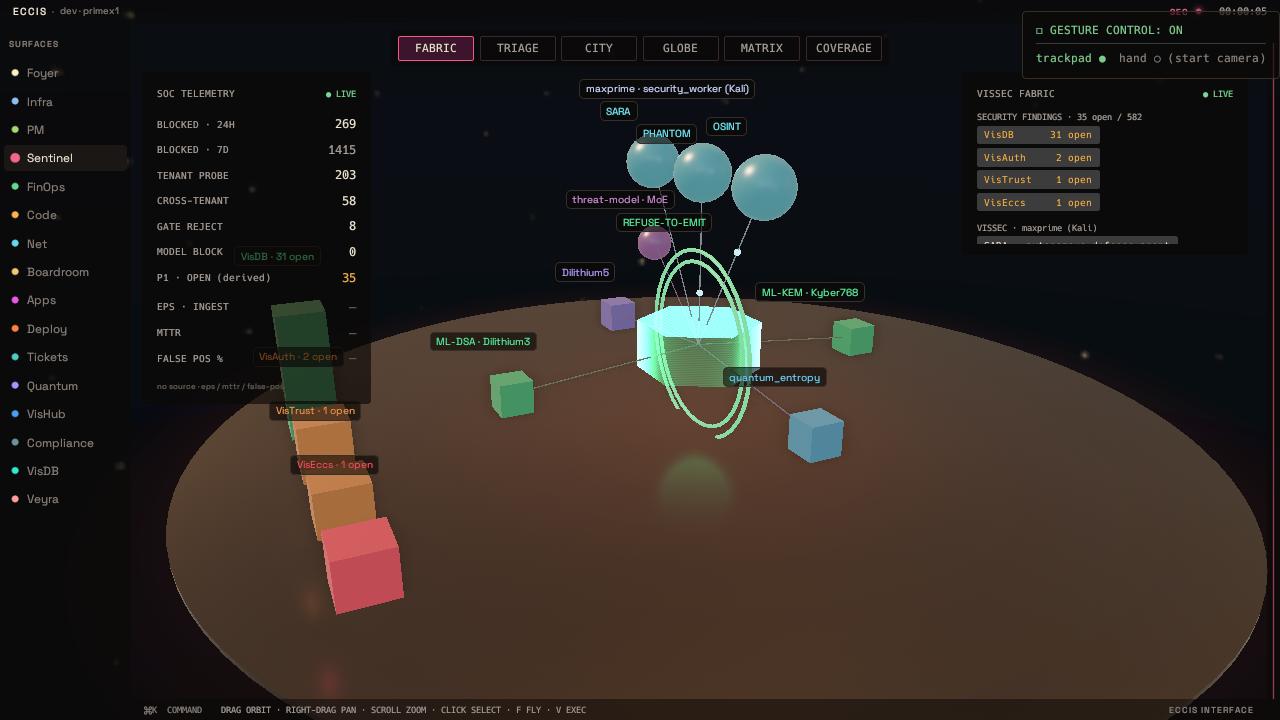
Eccis product view
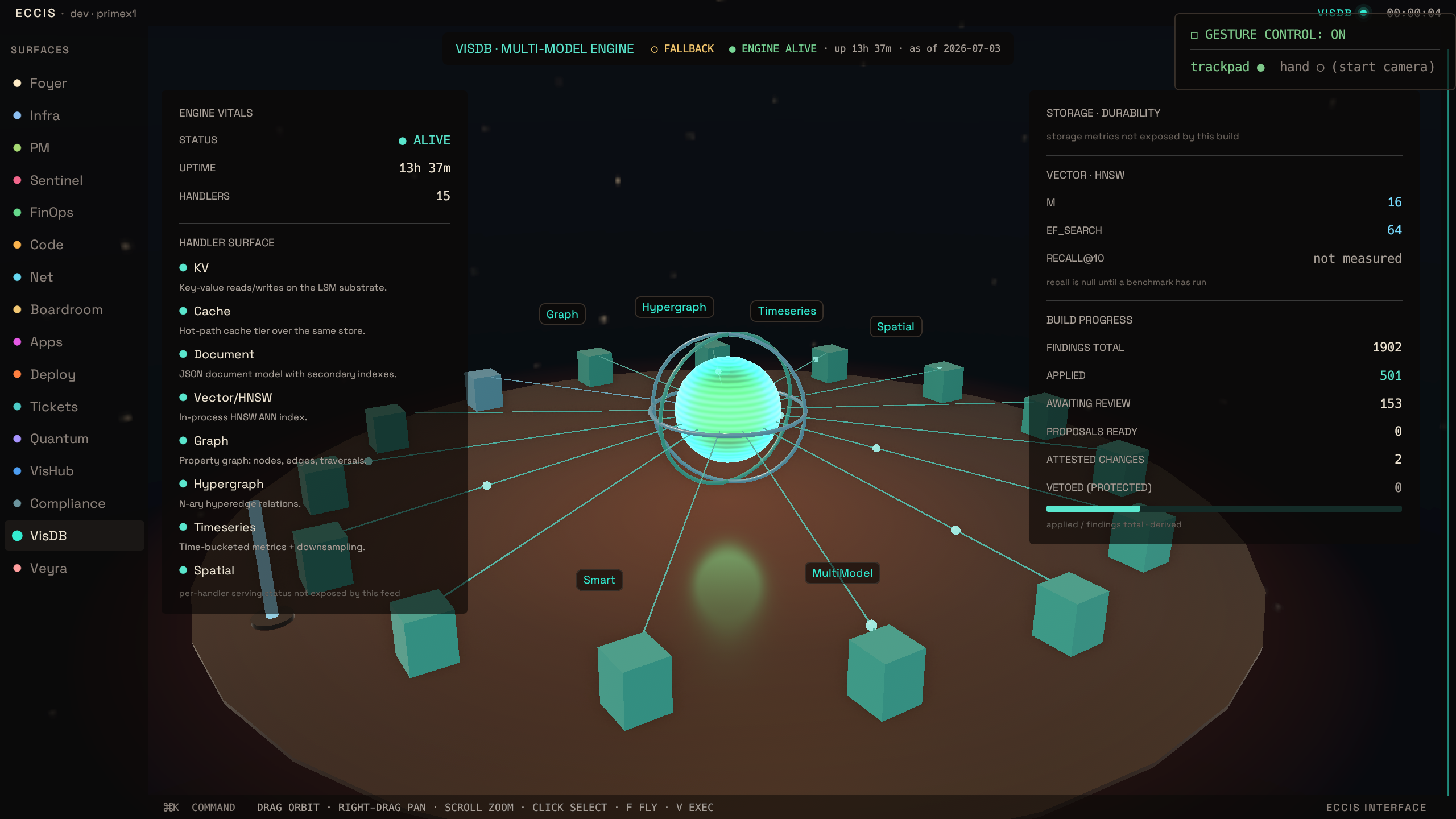
Eccis visual operating layer
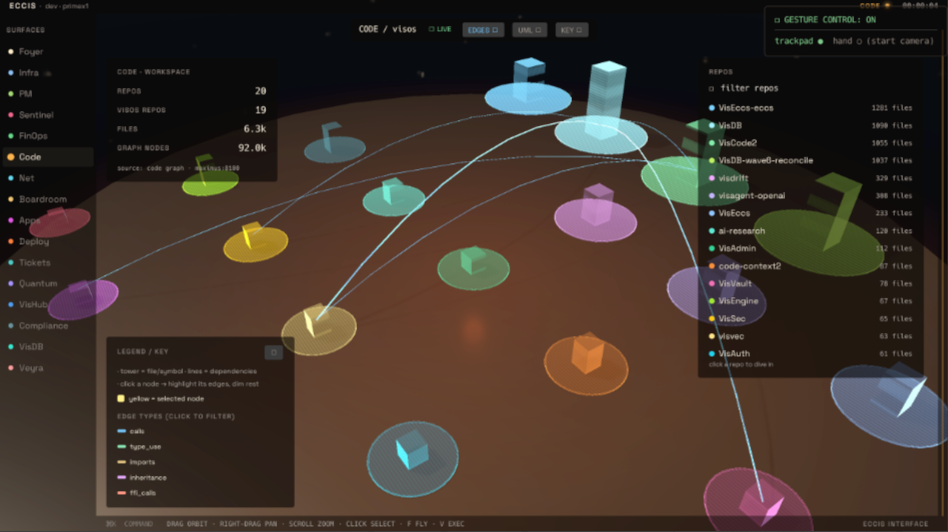
Dependency and blast-radius view
FIRST PRINCIPLE
Understanding earns the right to recommend. Governance decides when to act.
The future of enterprise AI is not blind automation.
A system that recommends action inside enterprise infrastructure must know what changed, what it touches, what rule it may violate, what risk it creates, what approval it needs, and how the action will be recorded.
↑ continuous loop
Your auditors can replay every action the system ever took.
MAXIMUS BLACKBOURNE, CTO
Action and Governance
Eccis moves from understanding to action through a governed loop: understand, reason, recommend, approve, act, audit.
The system is designed for recommended actions, not blind automation. Every action respects approval boundaries, policy controls, compliance impact, permission scope, rollback planning, and auditability.
Governance comes before execution.
When the change is infrastructure, Eccis writes the remediation plan itself: ordered by dependency, with safety checks and a reversibility analysis that flags any irreversible step before anyone approves it. Plans wait. The operator approves the plan or skips individual steps. On execution, every change is verified by reading the system back. On failure, prior steps roll back automatically.
Before any change executes, it passes the gate stack: structural verification across fourteen languages, source-grounding verification against real system state, a canary gate, protected-path controls, and an independent verdict. A second model reviews every change. Higher-stakes changes go before a jury of independent models that must agree. Any of them can veto, and a veto reverts automatically.
No single model's opinion is trusted.
Every applied change lands in the attestation ledger: the diff hash, the exact context hash that produced it, the gates it passed, compile and test results, the verifier's verdict. All of it chained by hash to every change before it.
Tamper-evident. Post-quantum signed.
The same governance discipline, whether the change is a line of code or a cluster resource: propose, gate, verify, apply, read back, revert on failure, record.
BUILT BY ITSELF
Eccis runs on Eccis.
The system indexed its own codebase before anyone else's. It watches its own fleet, reasons over its own architecture, and repairs its own defects through the same gates it offers you. Eccis eats its own dogfood, literally: every fix to itself passes the same gate stack it puts you through.
When its own build broke, Eccis found the break, opened the finding at the exact file and line, wrote the fix, put it before the jury, signed the receipt, and shipped the commit. No human wrote a line.
That is not a demo. It is how the system is maintained. Every fix it makes to itself passes the same gate stack, lands in the same ledger, and can be replayed by the same audit.
The hardest customer was the first one: ourselves.
We keep every receipt.
FIRST PRINCIPLE
Where reasoning happens is part of the architecture.
For many enterprises, the question is not only whether AI can reason. It is where the reasoning happens, where the context lives, who controls the environment, and whether sensitive operational knowledge ever leaves the boundary.
For government, defense, financial services, healthcare, critical infrastructure, and regulated enterprise, this is not a preference. It is an architectural requirement.
Sovereign, Private, and Air-Gapped Deployment
Eccis is designed for environments where enterprise context cannot leave the customer's control.
The reasoning layer runs inside a customer-controlled environment, with operational context, system memory, reasoning, and governed outputs kept inside the boundary.
Eccis is designed for private, sovereign, and air-gapped environments.
It runs on customer-controlled hardware.
It supports local and private models.
It has no required dependency on sending sensitive enterprise context to an external AI service.
Enterprise context stays inside the customer boundary.
The data path is post-quantum secured end to end.
Built for adversaries that do not exist yet.
WHAT ECCIS IS NOT
Adjacent to many categories. The same as none of them.
Technical buyers will try to place Eccis inside categories they already know. That is useful, but incomplete.
Observability shows what is happening. Eccis creates the shared understanding that lets engineers, security, compliance, leadership, and AI reason about what is happening together.
Security is one domain of understanding. Eccis reasons across security, infrastructure, cloud, applications, compliance, data, identity, and operational knowledge.
A database stores. Eccis understands. The data core exists because reasoning needs unified context across systems that were never designed to be understood together.
A dashboard is a place to look. Eccis is the model behind the view.
A copilot suggests beside a person. Eccis maintains the understanding that people, systems, and AI reason from.
One layer. Every tool, better.
Eccis is a sovereign reasoning and control layer for the enterprise technology surface.
UNDER THE HOOD
Verified context served from live system state.
Every change gated by an independent second model that can approve, veto, or revert.
A tamper-evident attestation ledger, post-quantum signed.
Zero lost writes under kill-testing.
No required external AI dependency, end to end.
CLOSING
The understanding enterprise AI needs before it can act.
Enterprise AI cannot reason safely from fragmented context.
Eccis creates the shared understanding layer that lets people, systems, and AI work from the same truth, inside the customer's own boundary.
The fragmentation ends.